CHAPTER ONE
The capital
Land, find your feet, and give Zagreb a proper day before turning south.
Tue · Jun 30Day 1
Arrive in Zagreb
Touch down at 10:40 AM on Austrian OS603 from Vienna. Collect the rental car, drop bags, and ease into the afternoon — coffee on Tkalčićeva, a wander through the Upper Town, dinner when you're ready.
Overnight — Zagreb, night 1 Maria's
In town — no driving
Wed · Jul 1Day 2
A full day in Zagreb
The Upper Town and St. Mark's, the morning bustle of Dolac market, Ban Jelačić Square, and the cathedral. Plenty of room for a museum or a long lunch — and perhaps time to call on Dominic and Rafael.
Read more on the Upper Town
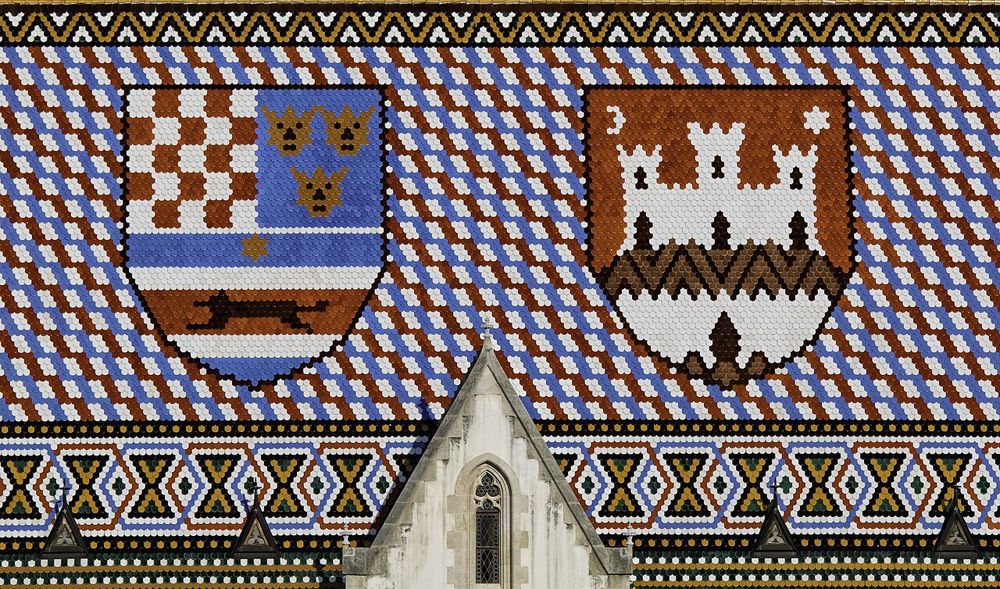
St. Mark's Church
The emblem of the Upper Town, its tiled roof laid in the 1880s with the medieval coats of arms of Croatia, Dalmatia and Slavonia beside the city's own.
Read more ↗Museum of Broken Relationships
A genuinely one-of-a-kind museum: donated objects and the short, anonymous stories of the love that ended with them — by turns funny and devastating. It won a European award for innovation in 2011.
Read more ↗Lotrščak Tower & the Grič cannon
A 13th-century watchtower whose cannon has fired once at noon every day since 1877 — loud enough to make you jump. Climb it for a 360° view across the rooftops.
Read more ↗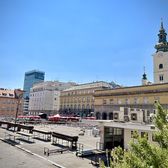
Dolac & the funicular
The red-parasol "belly of Zagreb" market sits just above Ban Jelačić Square — a 60-second ride up from the Lower Town on one of the shortest funiculars in the world.
Overnight — Zagreb, night 2 Maria's
Zagreb → Plitvice · ~1 hr 57 min · leave by 7 AMDriveGoogleApple
CHAPTER TWO
West to the coast
The lakes, then over the hills and down to the family base in the Ćićarija.
Thu · Jul 2Day 3
Plitvice Lakes
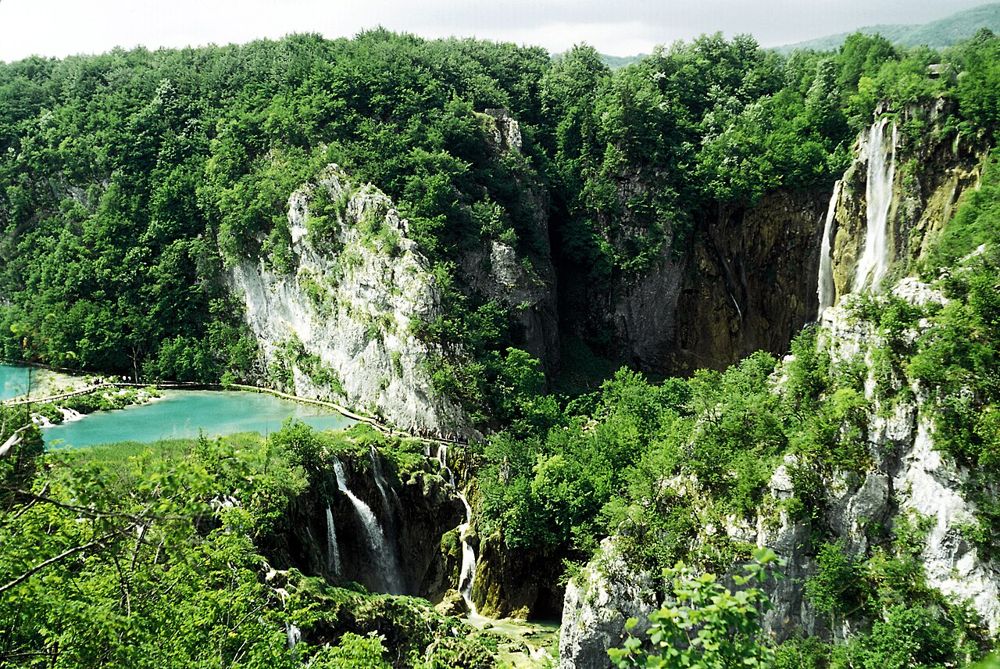
Drive down to the national park and spend a good part of the day on the boardwalks — sixteen terraced lakes spilling into one another, turquoise water, and Veliki Slap, Croatia's tallest waterfall at 78 m. The ticket also covers the panoramic train and the boat across Lake Kozjak. Entrance 1 reaches the Lower Lakes and Veliki Slap; Entrance 2 starts at the Upper Lakes.
Plitvička jezera NPVeliki Slap
Book ahead — this one matters. Buy a timed slot on the official site (np-plitvicka-jezera.hr) well before you go; peak-summer slots sell out weeks out. Adult entry runs €40 (€25 after 4 PM), and you must arrive within 55 minutes of your slot.
Plitvice, in depth
Sixteen lakes & Veliki Slap
The lakes step down through travertine barriers that are still slowly growing, each spilling into the next; Veliki Slap, at about 78 m, is the tallest waterfall in Croatia.
Read more ↗Tickets & getting around
Entry is a timed slot booked on the official park site; the ticket also covers the panoramic shuttle train and the electric boat across Lake Kozjak. Arrive within 55 minutes of your slot.
Official site ↗World Heritage
One of the oldest national parks in southeast Europe and a UNESCO World Heritage Site since 1979.
UNESCO listing ↗
Overnight — Plitvice, 1 night Airbnb
Plitvice → Opatija → Lanišće · ~2 hr 45 min + ~1–1¼ hrDriveGoogleApple
Fri · Jul 3Day 4
Over to Lanišće
West to the Adriatic for an afternoon at the beach in Opatija — the grand old Habsburg resort strung along the Kvarner gulf — before the climb up into the Ćićarija hills to Lanišće.
Opatija — beach
Read more on Opatija & the base
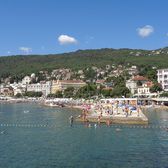
Opatija & the beach
The genteel "Pearl of the Adriatic," a Habsburg-era resort on the Kvarner gulf. Its beaches are pebble and concrete bathing platforms rather than sand, but the water is clear and Blue-Flag clean — central Slatina is the family hub, with gentler pebble swimming at Ičići and Medveja just to the south.
Read more ↗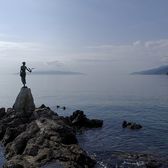
The Lungomare & the Maiden with the Seagull
A seaside promenade runs about 12 km along the riviera past belle-époque villas, linking the bathing spots from Volosko to Lovran. Its landmark is the Maiden with the Seagull — the bronze on the rocks that has become the symbol of the town.
Lanišće & the Ćićarija
Your base is a small village in the Ćićarija, the karst highland ridge along the Slovenian border at the top of Istria — quiet and green, with the hill towns all within easy reach.
Read more ↗
Overnight — Lanišće, night 1 Baba & Dide's
CHAPTER THREE
Lanišće — the family base
Three nights in one place. Truffle country on the doorstep, and the day everyone came for.
Sat · Jul 4Day 5
Hill towns & truffle country
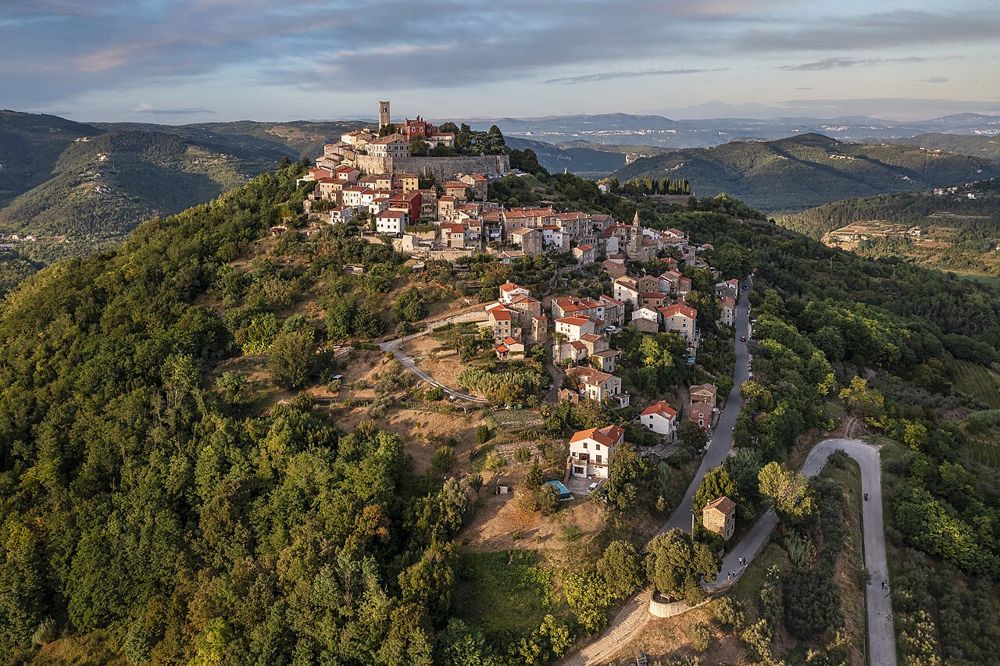
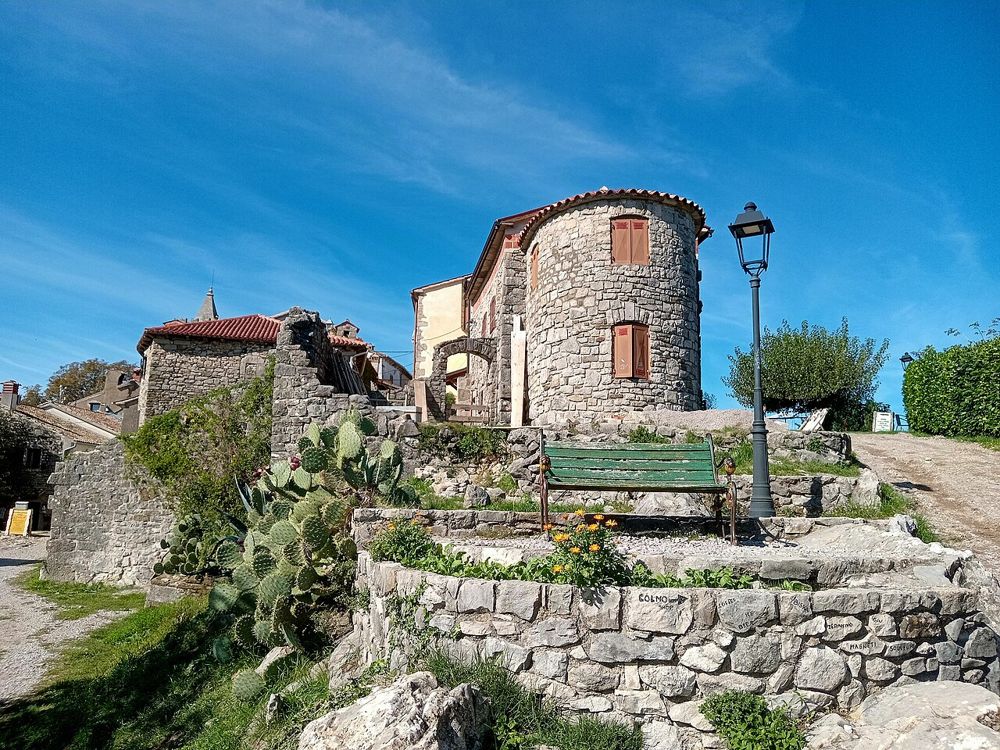
The base sits right among the gems. Drop down to Roč, an old Glagolitic town, and follow the Glagolitic Alley — a run of stone monuments to the ancient Slavic script — to Hum, billed as the smallest town in the world (you can walk it in five minutes; it's also the home of biska, the local mistletoe brandy). Nearby Kotli has old watermills and cauldron pools on the Mirna. Then west to Buzet, the truffle capital, and Livade at the foot of Motovun for truffles and the hilltop ramparts. Wind back to base in good time to get ready for tomorrow's party.
RočGlagolitic AlleyHumKotliBuzetMotovun & Livade
Two notes. Lake Butoniga is a drinking-water reservoir — no swimming, but a fine viewpoint along the way. And the Istarske Toplice spa is medicinal (a sulfur thermal pool and massages) rather than a recreational pool — call ahead if you want a soak.
Read more on the hill towns
Roč & the Glagolitic Alley
A trail of stone monuments between Roč and Hum honouring the Glagolitic script — the oldest known Slavic alphabet, kept alive in this corner of Istria long after it faded elsewhere.
Read more ↗Hum — the smallest town in the world
A single walled lane you can walk in a few minutes, with a town gate, a church and a handful of houses. It's also the home of biska, a local mistletoe brandy.
Motovun & truffle country
Buzet styles itself Istria's "City of Truffles"; below the ramparts of hilltop Motovun, the Mirna valley and Livade are prime hunting ground for white and black truffles.
Read more ↗
Overnight — Lanišće, night 2 Baba & Dide's
Based in Lanišće
Sun · Jul 5Day 6
Church & the family party
The heart of the trip. Church in the morning, then the family gathering — a day for relatives and the table, not the road.
Overnight — Lanišće, night 3 Baba & Dide's
Lanišće → Pula · ~1 hr 30–45 min · early startDriveGoogleApple
CHAPTER FOUR
The Istrian coast
Down to the Roman south, then back up the west coast through the prettiest towns on the peninsula.
Mon · Jul 6Day 7
Pula
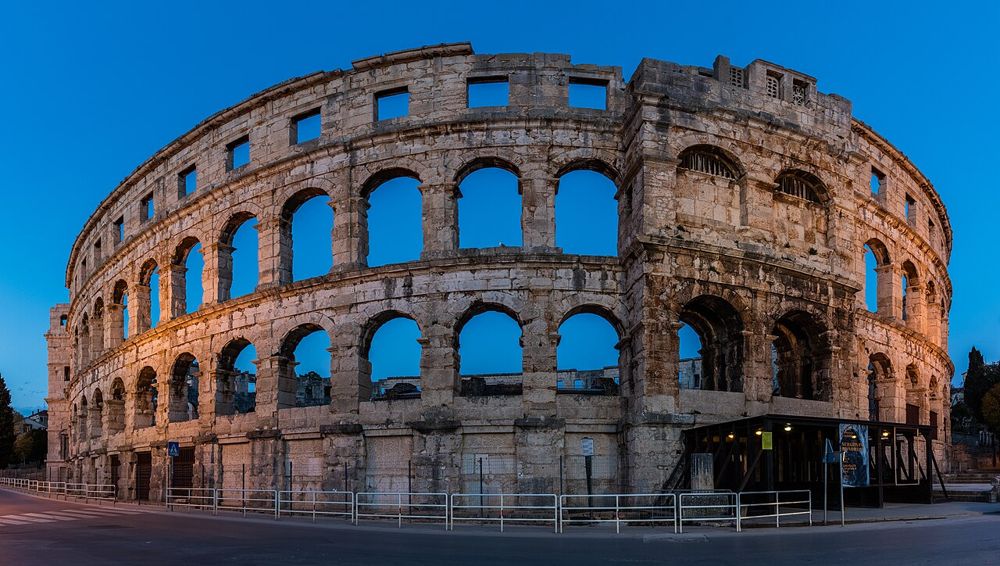
To the southern tip and one of the best-preserved Roman amphitheaters anywhere — don't skip the underground passages, now set up as a museum. Add the Temple of Augustus and forum, the Arch of the Sergii, the Zerostrasse WWI tunnels beneath the old town, and a nod to James Joyce, who taught English here.
Pula ArenaTemple of Augustus & forumArch of the SergiiZerostrasse
Timing. The Pula Film Festival opens July 9 — just after you fly out — so the 6th stays calm. Worth a glance at the Arena's summer concert calendar for that night.
Read more on Pula
The Arena
One of the largest and best-preserved Roman amphitheatres anywhere, built in the 1st century and still hosting summer concerts. The underground passages, where animals and gladiators once waited, are now a small museum.
Read more ↗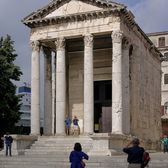
The Roman old town
The Temple of Augustus and forum, the triumphal Arch of the Sergii, and the Zerostrasse — a network of tunnels dug beneath the town for shelter in the First World War.
Read more ↗A literary footnote
James Joyce taught English in Pula over the winter of 1904–05; a statue of him sits outside a café he is said to have favoured.
Where you're staying. With Barba Mario & Teta Silvana, or Barba Vlado & Teta Maria — to be confirmed.
Overnight — Pula, 1 night with family
Pula → Rovinj → Poreč → Novigrad · ~35m + ~40m + ~25mDriveGoogleApple
Tue · Jul 7Day 8
The west-coast drive
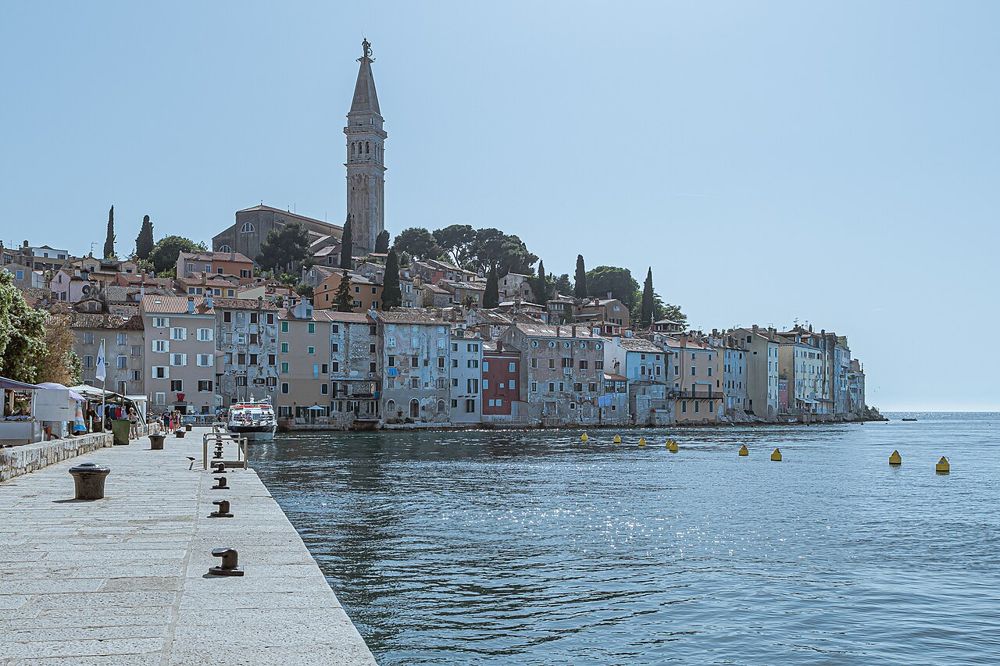
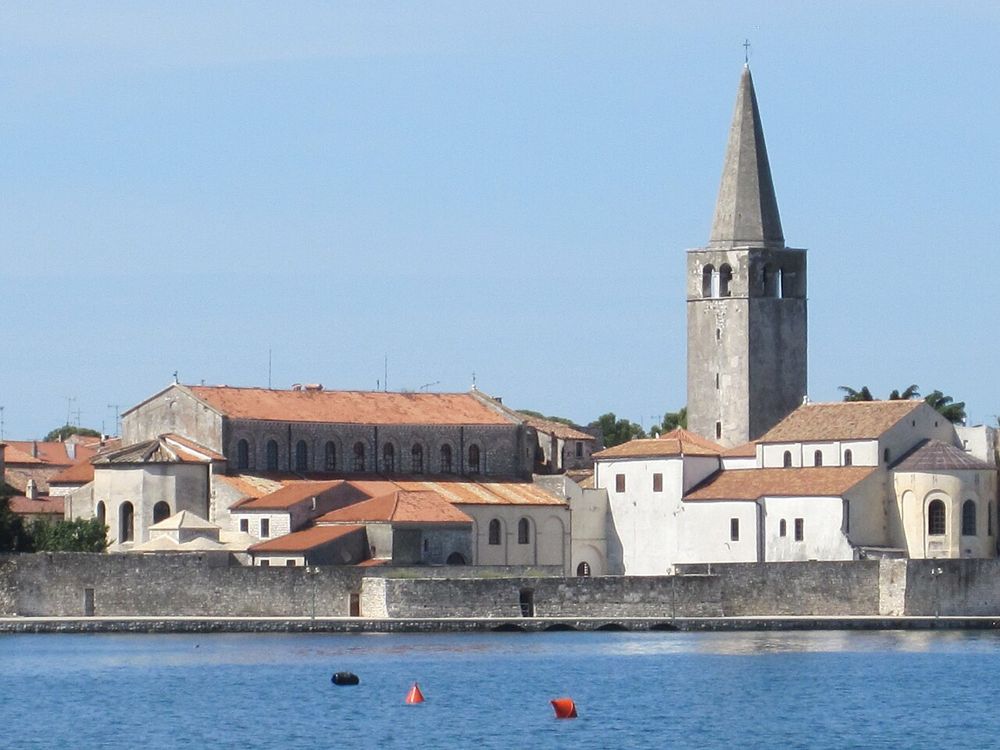
A string of stops up the coast. In Rovinj, climb Grisia — the artists' lane — to St. Euphemia, whose Venetian bell tower is topped by a copper weathervane of the saint that sailors still read for the weather; the Batana eco-museum on the waterfront is worth a look too. Poreč holds the Euphrasian Basilica, a 6th-century complex of gold Byzantine mosaics on the UNESCO list, with a climbable tower. Just inland near Nova Vas, Baredine Cave drops through five chambers to an underground lake and its resident olm — the "human fish." Then into Novigrad, a quiet Venetian-walled fishing town, for the night and good seafood.
RovinjPorečBaredine CaveNovigrad
Baredine. Guided visits run about every 30 minutes (~40 min, around €11, no booking needed) — and it stays cool underground, so bring a layer.
Read more along the coast
Rovinj & St. Euphemia
Climb the artists' lane of Grisia to the Baroque church of St. Euphemia; its Venetian-style bell tower is crowned by a copper weathervane of the saint that turns with the wind.
Read more ↗Poreč — the Euphrasian Basilica
A 6th-century early-Christian complex glowing with gold Byzantine mosaics, among the finest anywhere and on the UNESCO World Heritage list. The bell tower is climbable.
UNESCO listing ↗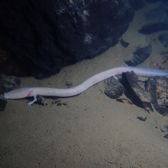
Baredine Cave
Near Nova Vas, a show cave dropping through five chambers to an underground pool — home to the olm, the pale, blind cave salamander known locally as the "human fish."
Read more ↗
Overnight — Novigrad, 1 night Maksi
Novigrad → Venice → Trieste · ~2¼–2⅔ hr + ~1 hr 39 min · leave very earlyDriveGoogleApple
CHAPTER FIVE
Into Italy & home
A day across the border, an overnight in Trieste, and the morning run back to Zagreb.
Wed · Jul 8Day 9
Venice, then Trieste
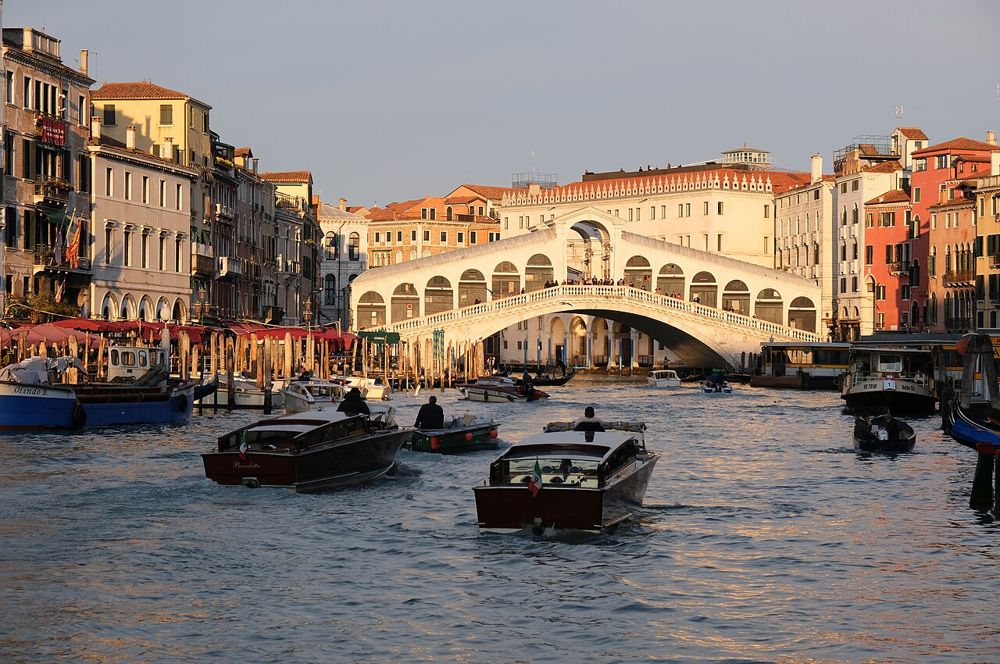
Cross into Italy for a day in Venice — park at Tronchetto or Mestre and take the water in — then an evening transfer along the coast to Trieste for the night.
VeniceTrieste
Heaviest driving day. It pairs the Novigrad–Venice run with the evening hop to Trieste — leave Novigrad very early so Venice doesn't feel rushed.
Read more on Venice & Trieste
Venice
Park at Tronchetto or over in Mestre and come in by water. The historic centre — St. Mark's, the Rialto, the Grand Canal — is entirely car-free and best taken on foot and by vaporetto.
Read more ↗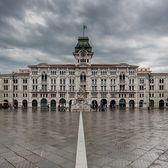
Trieste
An elegant former Habsburg seaport in Italy's far northeast, famous for the vast Piazza Unità d'Italia opening straight onto the Adriatic and for a coffee-house culture all its own.
Read more ↗
Overnight — Trieste, 1 night Teta Cila
Trieste → Zagreb airport · ~2 hr 18 min · leave by 8 AMDriveGoogleApple
Thu · Jul 9Day 10
Back to Zagreb — fly home
An early start back to the airport. Drop-off at departures, then the car stays in Croatia — so there's no rental return to time. Aim to be at the airport by about 10:20 AM for the 1:20 PM flight to Munich.
Leave by 8 AM. The drive is ~2 hr 18 min, so leaving Trieste no later than 8:00 AM puts you at the airport around 10:20 — a comfortable buffer (about three hours) for the 1:20 PM flight.
Trip ends — flight home
Flights
Itinerary #73407884870207 · Austrian confirmation CYGTQG
Outbound — Mon, Jun 29
Cleveland → Washington
3:02 – 4:20 PM
Washington → Vienna
5:25 PM – 8:10 AM +1
Vienna → Zagreb
9:50 – 10:40 AM
Arrives Tue Jun 30 · Austrian OS603
Return — Thu, Jul 9
Zagreb → Munich
1:20 – 2:30 PM
Munich → Washington
4:20 – 7:25 PM
Washington → Cleveland
10:15 – 11:44 PM
Home same night, Thu Jul 9
Good to know
A few things to line up before and during the trip.
- 01Plitvice tickets. Timed entry on the official site (np-plitvicka-jezera.hr); peak-summer slots sell out weeks ahead, and you must arrive within 55 minutes of your slot.
- 02Cross-border car. The loop dips into Slovenia and Italy — confirm the rental contract allows cross-border driving (some add a fee or need notice).
- 03Departure day. The car continues on in Croatia, so no return to schedule — just be at Zagreb airport by about 10:20 AM (roughly three hours) for the 1:20 PM flight, leaving Trieste no later than 8:00 AM.
- 04Some euros on hand. Hill-town konobas and small stops go smoother with a little cash, even though cards are widely accepted.
- 05Directions, tap-ready. Every drive leg above has Google and Apple Maps links for live turn-by-turn — nothing to type. Door-to-door from your exact lodgings can still be slotted in once you have the addresses.
- 06Keep it on your phone. Open this page in your browser's share/menu and choose Add to Home Screen (or Install). It saves the whole guide — photos and all — so it works with no signal as you cross between Croatia, Slovenia and Italy.
Before you fly
What you can and can't carry through the airport — and what's allowed back into the US.
- 01Liquids, US side. TSA's 3-1-1 rule still applies in 2026: liquids, gels and aerosols only in containers of 3.4 oz / 100 ml or smaller, all zipped into one quart-size bag per person. Newer scanners at some airports may let you leave the bag packed, but the size limit hasn't changed — anything bigger goes in the checked bag.
- 02Liquids, Europe side. The EU's 100 ml-in-a-1-litre-bag rule applies right across Croatia, Slovenia and Italy. A handful of airports and lanes — some at Munich among them — now allow up to 2 litres with new scanners, but it's inconsistent and rarely signposted. Pack to the 100 ml rule both ways and treat anything more as a bonus.
- 03Power banks & spare batteries. These ride in carry-on only — never checked. As of 2026 it's two power banks per person, no recharging them in flight, and US airlines now want them kept within reach (seat pocket or under the seat), not in the overhead bin. Keep them under 100 Wh — nearly all are — and protect any loose battery terminals with tape or a case.
- 04Sharp things and tools → checked bag. Knives, larger scissors, loose razor blades and multi-tools won't clear security; pack them in checked luggage. Disposable razors and small round-tip scissors are fine in the cabin.
- 05Meds and the kids' things are exempt. Prescription and over-the-counter liquid medicines — and baby food or drinks if they apply — can exceed the liquid limit in reasonable amounts. Just take them out and mention them at the checkpoint, ideally in their original labelled packaging.
- 06Duty-free has a catch on the way home. Bottles bought past security in Europe come sealed in a tamper-evident bag with the receipt — fine onward — but you re-clear security at the Washington connection, where foreign duty-free liquids can be pulled. Buy them after your last security check, or move them into a checked bag once you land in the US.
- 07Edible souvenirs — what makes it home. US customs is strict on animal products: cured meats and salami (pršut, prosciutto, salami), fresh produce, soft or runny cheeses and fresh truffles are not allowed in. Hard and semi-hard cheeses, sealed olive oil, honey, jam, packaged spices, chocolate, sealed truffle products and bakery items generally are. Declare all food on the customs form — declared items that aren't allowed are simply taken, while undeclared ones risk a fine.